
AI Built for Better Decision Making
As artificial intelligence reshapes the future of defense, one of the biggest challenges isn’t simply processing more data, it’s helping people make better decisions with it. That theme is at the heart of Jackie Barbieri’s recent TEDxWarrenton talk, How to Use AI to Think Like a Superhuman, where she explores how human-machine teaming can dramatically improve cognitive decision-making.
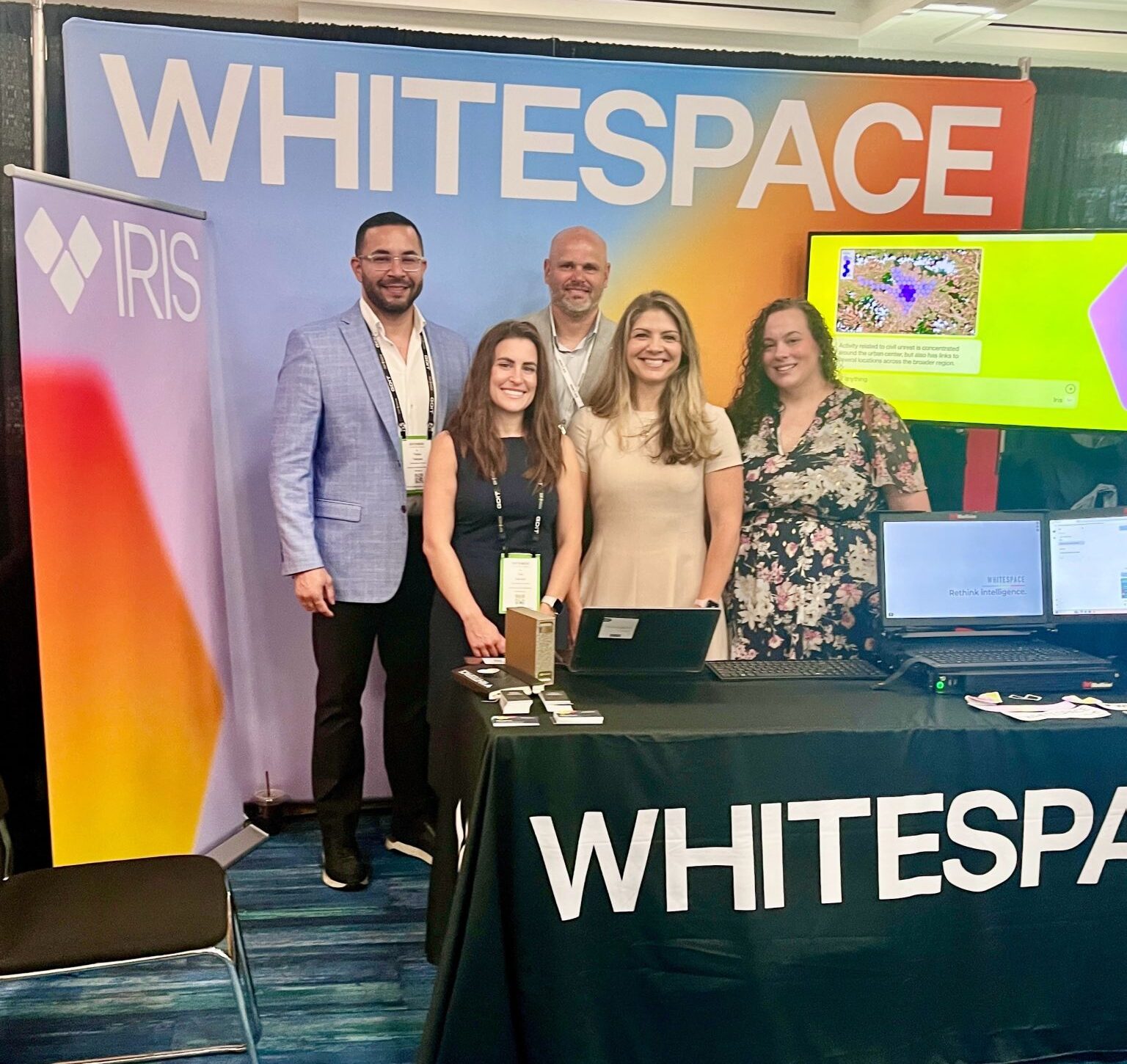
That same philosophy is the driving force behind Whitespace, the company Barbieri founded in 2014 to bridge the gap between intelligence analysis and operational decision-making. As the volume of data available to defense and national security organizations continues to grow, the challenge is no longer collecting information—it’s turning that information into timely, actionable insights. Through its AI-enabled platform, Iris, Whitespace applies activity-based intelligence (ABI) tradecraft to help analysts and operators make faster, more informed decisions across a wide range of missions, from maritime security and counter-narcotics to migration monitoring and national defense.
Northwest Tech Bridge recently caught up with Barbieri for a Q&A about the company’s origins, the philosophy behind “operating in the whitespace,” the value of partnering with the Navy innovation ecosystem, and her advice for innovators entering the defense market.
Q: The origin story. What problem did Whitespace set out to solve, and how has the mission evolved?
I started Whitespace in 2014 because of a gap I had seen up close. There has always been distance between what analysts know and what operators need in the moment. Every operator needs intelligence, but not every operator has an analyst. I had sat with operators in high-stakes environments and watched that gap cost people. I believed it could close, not by hiring more analysts, but by scaling the tradecraft itself.
Since then, the problem hasn’t gone away. If anything, it has gotten more acute. There are more sensors, more data, and more varied and dynamic mission sets than ever, and there are not enough people to make sense of it all. The result is cognitive overload at exactly the moment when speed matters most.
What has changed is the appetite for solving it. There is real openness now to novel technical approaches, more than I have seen at any point in the last decade. That gives us room to solve a long-standing problem in an unconventional way.
Q: What does “operating in the whitespace” mean to you?
The whitespace is the gap between intelligence and operations, between data and the decision it is supposed to inform. It is where the answer already exists in the data but never reaches the person who needs it in time. That is the gap we set out to close.
Q: One of the most surprising insights you’ve encountered in your data work?
One that stays with me comes from our work on shadow tanker activity. We were tracking vessels we believed were moving sanctioned cargo through ship-to-ship transfers, the kind where both vessels go dark and switch off their AIS so there is no track to follow. The usual assumption is that once a vessel goes dark, you’ve lost it. We found you actually haven’t.
By correlating the activity we could still see, Iris helped us tip and cue satellite collection to the right window, and we caught an illegal transfer in the act. The part that mattered was not confirming the event. It was identifying the second vessel, one we had not known was part of the illicit network. We learned that what’s absent from the data often tells you as much as what is present in it.
Q: How has partnering with Northwest Tech Bridge influenced Whitespace’s growth or reach?
Northwest Tech Bridge has been a valuable connector for us. The clearest benefit has been access to the people and the ecosystem across the Navy. You’ve made introductions, helped us understand how this community works, and given us useful feedback on our Phase I SBIR effort. For a company that spent its early years heads-down on the mission, having a partner who can open the right doors and help us learn the landscape faster genuinely matters. We’re still early in the relationship and look forward to building on it.
Q: Iris supports very different missions. How does one system flex across all of them?
What stays constant is the methodology. Iris is built on activity-based intelligence (ABI) tradecraft, and that core holds from one mission to the next. What changes is what we point her at. The same system that tracks vessel behavior at sea can be configured for counter-narcotics work or for monitoring migration patterns. We tune her to the data types, feeds, and workflows that matter for a given mission. She is just as flexible in how she deploys, whether that’s the cloud, on-prem, or at the edge in a disconnected environment. That range is deliberate. While the missions vary widely, the need for fast, trustworthy analysis does not.
Q: What advice would you offer to innovators entering the defense innovation ecosystem with strong technical ideas but limited experience engaging government?
Be a sponge. Listen first and talk later. The instinct when you have a strong technical idea is to come in and sell it, to map your solution onto the first problem that looks like a fit. I would resist that. Spend the time to really understand the customer’s problem before you decide how your technology meets it. Come in with an open mind, because you will often be surprised by what you find. The better you understand the actual problem, the better the thing you build to solve it. That order matters more than people think.
Whitespace’s journey reflects a growing shift across the defense innovation ecosystem, one where advanced AI, activity-based intelligence, and close collaboration with end users are helping solve longstanding operational challenges. By focusing on the needs of the mission first, the company is demonstrating how emerging technologies can deliver meaningful impact across a wide range of defense applications.