
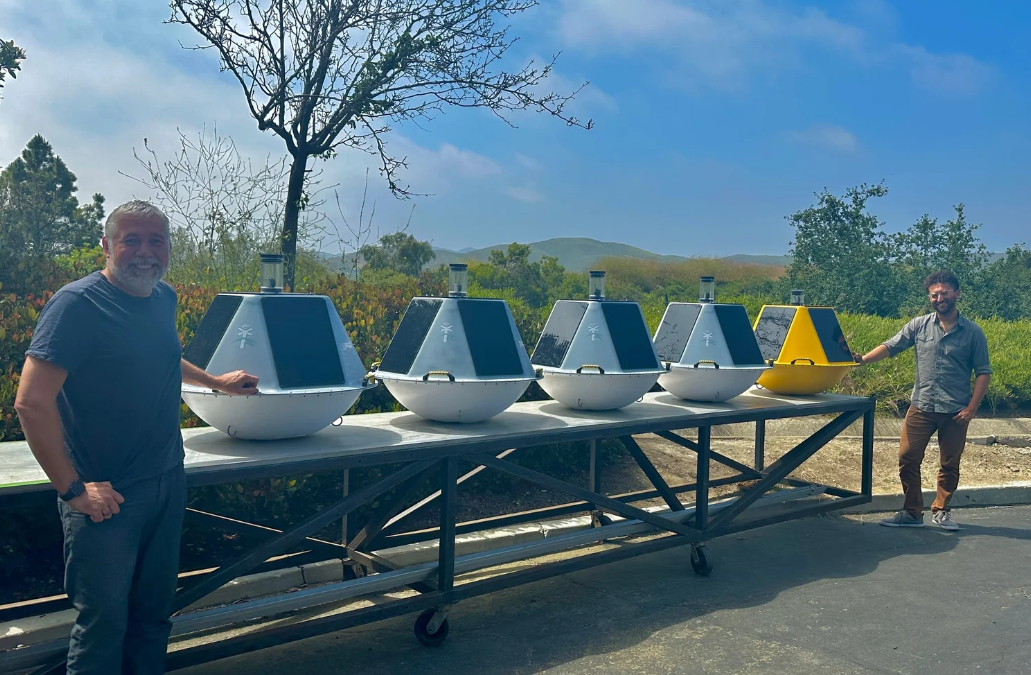
Advancing the Future of Ocean Intelligence
At NW Tech Bridge, we have the opportunity to work with innovative companies tackling real-world challenges for the Department of the Navy and the broader defense community. This month, we sat down with Dr. Graeme Rae, Founder and CEO of HyperKelp, a company transforming how data is collected across the world’s oceans through its intelligent, modular Kelp Smart Buoy platform.
In this Q&A session, Graeme shares HyperKelp’s founding story, the evolution of its technology, the importance of understanding mission needs before building solutions, and the lessons learned bringing innovative capabilities to the defense ecosystem. He also discusses how collaboration with government partners has helped accelerate the company’s growth and support the needs of the warfighter.
Q: Can you tell us the story behind HyperKelp’s founding?
HyperKelp was founded from a simple observation: the oceans remain one of the least instrumented environments on Earth. We have satellites watching every corner of the planet from space, but collecting persistent data from the ocean is still expensive, difficult, and often requires ships and people in the field.
My background is in ocean engineering, AI, and autonomous systems, and over the years I saw the same problem repeated across defense, science, offshore energy, and environmental monitoring. Everyone needed affordable, long-endurance sensing, but existing solutions were either too costly, too specialized, or too difficult to deploy at scale.
We started HyperKelp to change that by creating an affordable, modular smart buoy that could be deployed in large numbers and support almost any sensor or mission
Q: Can you explain how the Kelp Smart Buoy platform supports defense, environmental monitoring, and scientific research? How did you achieve that flexibility?
Rather than building a buoy for a single application, we built a platform.
The Kelp Smart Buoy is designed around a modular architecture that separates the core vehicle from the payload. That means the same buoy can carry acoustic sensors for maritime surveillance, environmental sensors for water quality, GNSS receivers for tsunami detection, or custom payloads for scientific research.
The platform also uses open interfaces, onboard edge computing, and flexible communications, allowing new sensors and software to be integrated without redesigning the buoy itself. That flexibility lets government agencies, researchers, and commercial users solve very different problems using the same proven platform.
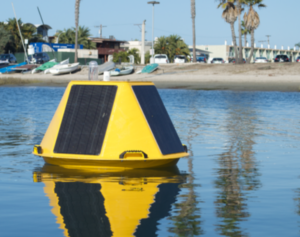
KSB-A – a versatile surface platform engineered for long-duration research, commercial monitoring, and persistent environmental awareness.
Q: HyperKelp has secured multiple Defense awards. What was the company’s first major funding award, and what did it enable you to accomplish?
Our first major defense award was a U.S. Navy SBIR Phase I.
That funding allowed us to transition from a promising prototype to an operational platform capable of surviving real-world deployments. We were able to mature the hardware, develop our onboard AI capabilities, conduct field trials with Navy stakeholders, and demonstrate that small, affordable smart buoys could deliver meaningful operational capability.
It was the step that transformed HyperKelp from a technology startup into a defense company. Not going to lie – getting that first Phase I was a real slog! It took a lot of meetings, conferences and failed submissions, but eventually the trust was built, and the first one led to more.
Q: What role has NW Tech Bridge played in your growth?
Despite being a Southwest company, the Northwest Tech Bridge realized the value of our tech and took us under their wing! NWTB has been an outstanding connector between innovators and the Department of the Navy, the connections we’ve made have lead directly to experiments and funding (our D2P2 with the USAF came from a connection we made in a presentation we gave for NWTB)
Beyond introducing us to potential users and partners, they’ve helped us better understand real operational challenges and identify where our technology can provide the greatest value. Just as importantly, they’ve created opportunities for collaboration across government, industry, and academia that would have been difficult for a small company to establish on its own.
Those relationships have directly contributed to new programs, demonstrations, and customer engagement.
Q: Oceans are some of the harshest operating environments on Earth. What has been the biggest engineering challenge in building the KSB?
The ocean is relentless!
Everything wants to corrode, leak, foul, or consume power. A buoy has to survive storms, saltwater, marine growth, extreme temperatures, and months of continuous operation while remaining small enough to deploy easily.
One of our biggest engineering challenges has been balancing endurance with size. Every watt matters, so we’ve spent years optimizing power consumption while still providing enough onboard processing to perform AI at the edge. The result is a system that can remain on station for extended periods while collecting and processing valuable data without requiring constant human intervention.
Q: Looking back at HyperKelp’s journey so far, what has been the biggest lesson you’ve learned about turning innovative technology into a capability that supports the warfighter?
The biggest lesson is that great technology alone isn’t enough. It takes some serious self-reflection for many engineers to realize that while they may have the greatest widget, that is technologically amazing, unless it solves a REAL problem it’s essentially worthless.
The warfighter doesn’t need another interesting prototype – they need something that is reliable, easy to deploy, integrates into existing workflows, and solves a real operational problem.
That means spending time with end users, listening carefully to feedback, testing in realistic conditions, and being willing to change the product based on what operators actually need rather than what engineers think is interesting.
Ultimately, success comes from solving operational problems, not just technical ones. “What does it do” is way more important than “How does it do it”
Q: What advice would you give other innovators trying to bring new technologies into the defense ecosystem?
Spend as much time understanding the mission as you do building the technology.Talk to operators early and often. Government run Experiments are absolutely critical. Get your system into the field quickly, even if it’s not perfect, because you’ll learn far more from operational feedback than you will in the lab.Be patient. Despite all the amazing changes in the ecosystem over the past year or so to speed things up, it takes a long time to find the right end-user and the right funding vehicle. Defense acquisition takes time, and trust is earned through consistent delivery. Focus on building relationships, demonstrating reliability, and solving real problems. If you do that consistently, opportunities will follow.