Mission Meets Industry at the NWTB Tech Showcase
The future of defense innovation is no longer happening behind closed doors or inside isolated research labs. Increasingly, it is being shaped through direct collaboration between operators, engineers, entrepreneurs, manufacturers, and emerging technology companies working side-by-side to solve real-world mission challenges.
That reality was on full display on May 28th, when the Northwest Tech Bridge (NWTB), in partnership with the Pacific Northwest Mission Acceleration Center (PNWMAC) and the Pacific Northwest Defense Coalition (PNDC), hosted the NWTB Technology Showcase at the Port of Tacoma.
The event brought together Navy stakeholders, defense innovators, investors, industry leaders, and ecosystem partners for a focused day of technology discovery, operational problem-solving, and relationship building across the Pacific Northwest defense ecosystem.
But more importantly, the showcase reinforced something increasingly critical to national security:
Many of the solutions the Navy needs already exist inside the private sector. The challenge is accelerating the connection between innovators and mission owners quickly enough to matter.
That is exactly where Northwest Tech Bridge plays a critical role.
Real Navy Problems, Real Operational Urgency
Unlike traditional conferences centered around abstract future concepts, the Technology Showcase focused on validated operational needs currently impacting Navy maintenance, sustainment, inspection, and workforce readiness.
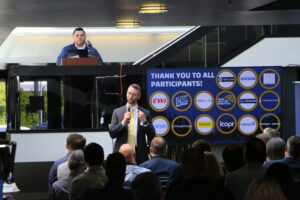
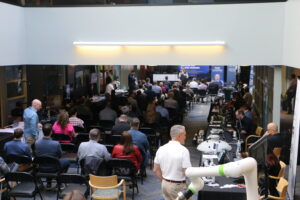
The event opened with remarks from leaders across the Pacific NW Defense Coalition, PNW Mission Acceleration Center, and the NW Tech Bridge, followed by a mission-focused briefing from Deniz Ferrin of NAVSEA 04 and Bryant Veach of Naval Undersea Warfare Center (NUWC) Division Keyport.
Their message was clear: the Navy is actively seeking technologies that can reduce maintenance timelines, improve inspection accuracy, enhance workforce readiness, lower operational costs, and strengthen fleet readiness across increasingly complex environments.
Among the operational challenges discussed:
- Corrosion control and restoration processes that remain labor-intensive, time-consuming, and hazardous for personnel.
- Workforce development systems that rely heavily on classroom instruction, mockups, and lengthy on-the-job familiarization.
- Remote troubleshooting limitations that force technicians and subject matter experts to diagnose mission-critical issues with incomplete information.
- Quality assurance and inspection bottlenecks that can increase maintenance delays and reduce first-time quality.
Importantly, Navy stakeholders emphasized that innovation does not always need to be revolutionary to deliver significant value. Incremental improvements that improve efficiency, safety, repeatability, or readiness at scale can generate enormous operational impact across the sustainment enterprise.
For innovators, that creates opportunity.
A Showcase of Emerging Defense Innovation
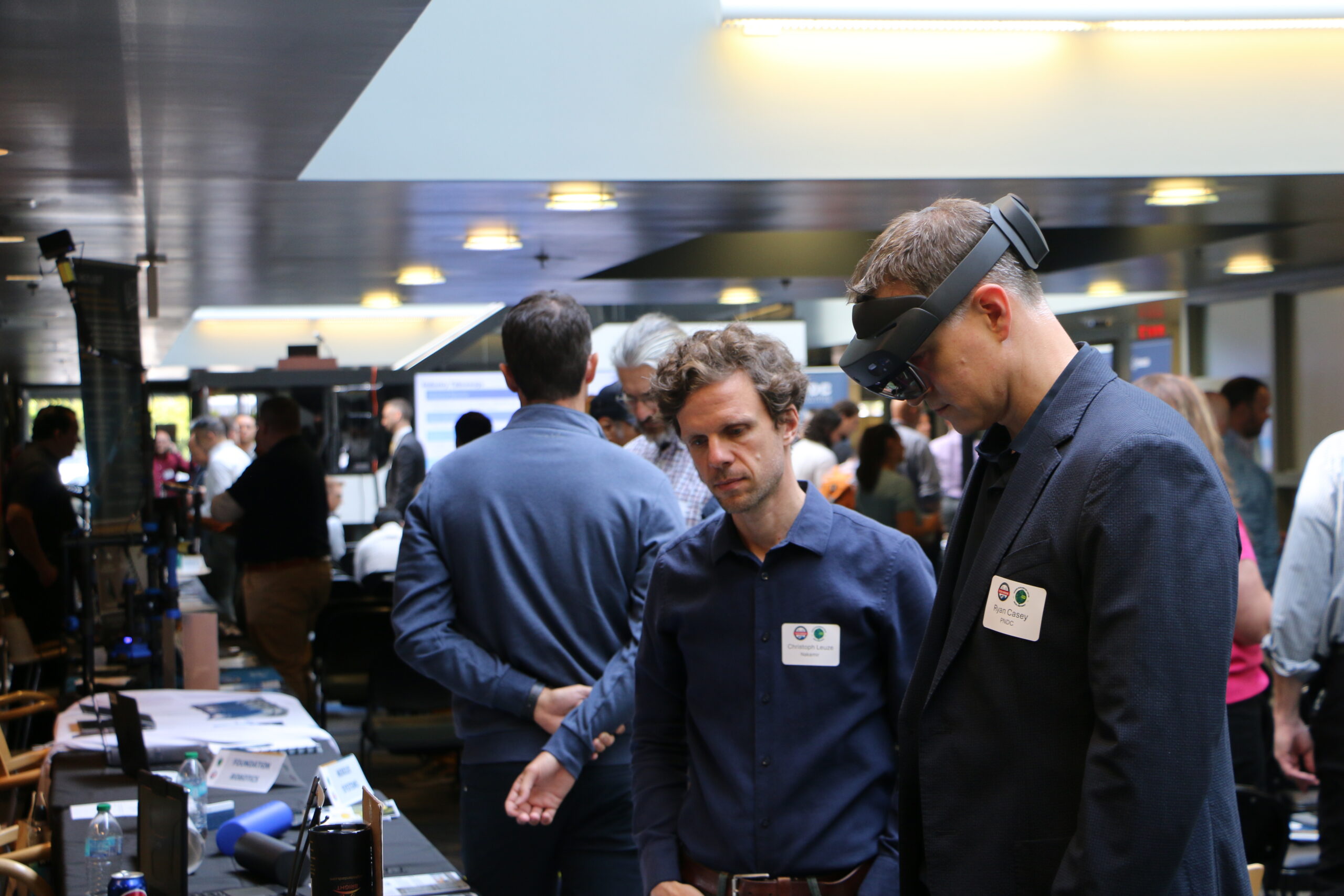
Fifteen companies delivered rapid-fire presentations showcasing technologies aligned with Navy priorities across robotics, artificial intelligence, advanced manufacturing, digital twins, inspection systems, workforce development, and autonomous operations.
Participating companies represented a broad cross-section of the innovation ecosystem, including:
- ARIS, showcasing scalable 3D scanning and digital twinning solutions.
- Asylon Robotics, presenting automated inspection technologies designed to improve consistency and efficiency.
- EWI, sharing large-scale additive manufacturing capabilities.
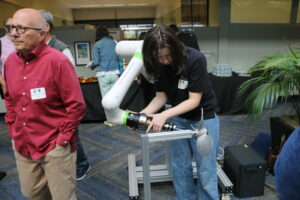
- FANUC Robotics, showcasing robotic applications for inspection, coating, welding, cleaning, and manufacturing.
- FARO Creaform, showcasing portable, high-accuracy 3D scanning and reverse engineering technologies.
- FLX Solutions, presenting robotic inspection technologies capable of reducing ship inspection timelines.
- Foundation Robotics, presenting robotic systems for hazardous and physically demanding tasks.
- GrayMatter Robotics, highlighting autonomous sanding, blasting, scanning, and digital twin technologies.
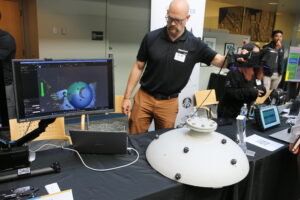
- GridRaster, demonstrating AI-powered processing and management of high-fidelity 3D data.
- Hexagon Manufacturing Intelligence, highlighting highly accurate measurement systems designed for defense environments.
- Loopr AI, presenting standardized inspection systems that improve repeatability and maintenance documentation.
- Nakamir, demonstrating AI-powered workforce training and knowledge capture technologies.
- Nereus Systems, showcasing robotic solutions designed for confined maritime environments.
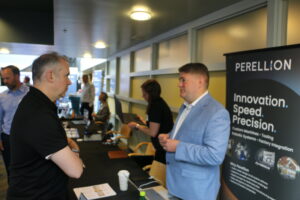
- Perellion, demonstrating advanced cleaning technologies supporting Navy shipyards.
- ThoughtForge AI, focused on robotic inspection in communication-denied confined spaces.
Collectively, the presentations illustrated how rapidly private-sector innovation is advancing in areas directly relevant to Navy sustainment and industrial modernization.
The technologies are no longer theoretical. Many are commercially viable, deployable, and capable of delivering measurable operational improvements today.
Connecting Innovation to Mission Needs
One of the strongest themes throughout the event was that successful innovation requires more than breakthrough technology. It requires trusted relationships between operators, innovators, industry partners, and organizations capable of helping bridge the gap between mission needs and emerging solutions.
For many startups and non-traditional defense companies, navigating the defense ecosystem can feel complex and difficult to access. At the same time, Navy stakeholders are actively looking for technologies that can improve readiness, strengthen sustainment operations, and help modernize critical systems.
Events like the NWTB Technology Showcase help create space for those conversations to happen directly.
By bringing Navy stakeholders, ecosystem partners, and innovators into the same room, the showcase helped strengthen connections across the Pacific Northwest defense innovation ecosystem while highlighting technologies with real operational relevance.
The event also reinforced the important role regional partnerships play in accelerating innovation. From industry groups and mission acceleration organizations to research institutions, manufacturers, investors, and government stakeholders, meaningful progress depends on collaboration across the broader ecosystem.
The Pacific Northwest is home to a growing network of companies developing advanced technologies in robotics, artificial intelligence, manufacturing, inspection systems, workforce training, and maritime operations. Creating stronger pathways between those innovators and validated mission needs will continue to be critical to strengthening both naval readiness and the defense industrial base.
Northwest Tech Bridge remains one part of that larger effort, supporting innovators through mentorship, technology transition assistance, connections to Navy stakeholders, and guidance on opportunities including SBIRs, OTAs, CRADAs, and other non-traditional pathways for collaboration and funding.
If your technology has potential defense applications, we encourage you to connect with Northwest Tech Bridge and explore opportunities to engage with the broader defense innovation ecosystem.
Learn more and request assistance at: https://nwtechbridge.org/request-assistance/